

When privacy matters: a practical case study of using a multi-currency privacy wallet for XMR, BTC and LTC
Imagine you’re in a small-business meetup in Austin and a client asks you to accept crypto payments for consulting: some will be Bitcoin, another portion in Litecoin, and one customer prefers Monero for stronger privacy. You want a single wallet that keeps keys local, preserves network-level anonymity for sensitive flows, and lets you convert across assets without leaking transaction patterns to a third-party exchange. This scenario is common for privacy-minded US users who juggle compliance, usability, and operational security. The choices you make—how you store seeds, which addresses you use, whether you route over Tor, and how you swap—determine the real-world privacy you actually get, not the marketing claims.
In this article I’ll walk through a realistic case: receiving a mix of XMR, BTC and LTC, consolidating into a business reserve, and sending payouts while minimizing linkability. I’ll explain the mechanisms the wallet uses, where privacy gains come from, the unavoidable trade-offs, and a practical decision framework you can reuse. The wallet examined operates non-custodially, supports Monero features like subaddresses and private view-key retention, integrates Bitcoin privacy tools, offers Litecoin MWEB, supports hardware devices, provides Tor/I2P routing, and has an on-device exchange. That combination addresses a lot of operational needs—but it also forces choices that change your privacy surface.
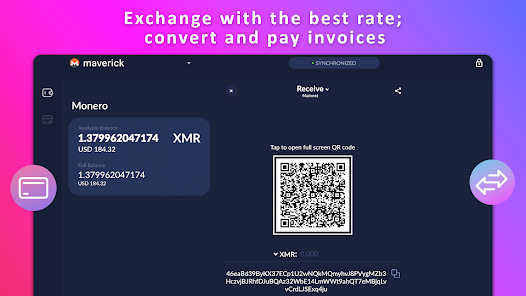
How the wallet protects privacy and where the protection comes from
At the device level, private keys and sensitive secrets are protected by hardware-backed encryption (Secure Enclave on iOS; TPM-capable protections on Android). That stops casual extraction if your phone is stolen, and access is gated behind a 4–6 digit PIN or biometrics. But hardware protection is only the first line: network privacy is a different layer. The wallet offers Tor-only mode and I2P proxy support and allows you to select your own remote nodes. Those features help prevent observers from associating IP-level metadata with on-chain activity—critical for users who care about linkability beyond blockchain analytics.
Monero’s privacy model is privacy-by-default: ring signatures, stealth addresses, and confidential transaction amounts. Practically, the wallet supports background synchronization and subaddresses, and it explicitly keeps the private view key on-device. That last point matters for auditing or view-only monitoring: the view key can reveal incoming transactions without exposing spend keys if used carefully, but keeping it local minimizes remote attack vectors.
Bitcoin privacy is mostly adversarial: the chain is public, so techniques reduce linkability rather than hide it completely. The wallet integrates concrete mitigations such as PayJoin v2 (which mixes inputs between payer and payee to break naive heuristics), Silent Payments (which reduce address reuse), UTXO coin control (to avoid accidental consolidation of distinct coins), and transaction batching. Those tools can substantially reduce heuristic linkages if used correctly, but they cannot replicate the on-chain anonymity of Monero.
Litecoin support includes optional integration with MWEB (MimbleWimble Extension Blocks). MWEB provides a privacy-enhancing layer where transaction graph information is not recorded in the same way. Enabling MWEB can shrink linkability for LTC flows, but it’s an optional feature and interoperability depends on counterparties and services supporting it.
Case walk-through: receive, consolidate, and payout with privacy in mind
Step 1 — receive: For Monero, use a unique subaddress per customer. That prevents receipt addresses from becoming shared identifiers; because subaddresses are standard in XMR, this is straightforward. For Bitcoin and Litecoin, prefer Silent Payments or unique receive descriptors if the payer supports it. If a payer cannot, instruct them to use a fresh native address and avoid address reuse.
Step 2 — protect network metadata: Immediately after receiving funds, open the wallet in Tor-only mode (or connect through an I2P proxy). If you rely on public nodes, switch to your own full node or a trusted remote node you control. In the US context, routing through Tor reduces the exposure to local ISP or platform telemetry; it does not make you invisible to blockchain analysts, but it severs one common cross-reference (IP + blockchain activity).
Step 3 — consolidate thoughtfully: If you need a reserve in BTC or LTC, avoid single-step consolidation that combines multiple UTXOs from different payers—this action creates linkage. Use coin control to sweep funds selectively and consider batching payouts where appropriate. For Monero, consolidation is less of a privacy risk because outputs are obfuscated; nevertheless, timing and reuse of outputs can create pattern signals, so staggered background sync and periodic wallet maintenance help.
Step 4 — swap in-wallet vs external exchange: The in-wallet swapping feature uses NEAR Intents for decentralized routing among market makers. That removes a centralized custodian from the equation and preserves non-custodial key control. But swaps create their own metadata traces: if you trade a rare token to XMR and immediately use XMR in a particular pattern, analysts can still form probabilistic connections across swap rails. Using batch swaps, avoiding immediate linking transactions, and spreading swaps across time windows reduces that risk.
Myths vs reality: three common misunderstandings
Myth 1 — “Using a privacy wallet makes me untraceable.” Reality: a privacy-focused wallet significantly reduces linkability, but it does not guarantee absolute anonymity. Network-level protections, on-chain privacy features, and non-custodial keys reduce attack surfaces, yet metadata correlation, behavioral patterns, and mistakes (address reuse, poor coin control) can still expose links.
Myth 2 — “In-wallet swaps are always private.” Reality: Decentralized routing (NEAR Intents) and non-custodial swaps remove centralized custodians, but swaps are still observable across chains and can be correlated by timing, amounts, and sequence. The wallet reduces counterparty risk and central points of failure, yet privacy depends on how swaps are sequenced and whether counterparties or relayers leak data.
Myth 3 — “Hardware wallets make privacy perfect.” Reality: Hardware wallets (Ledger, Cupcake) keep keys offline and greatly strengthen security, but they don’t solve network-level leakage or poor operational practices. A hardware device plugged into a phone that leaks IP metadata or a user who reuses addresses still creates privacy gaps.
Trade-offs, limits, and what can still go wrong
Trade-offs are unavoidable. Using Tor or I2P increases privacy but can degrade performance and complicate node connections. Increasing privacy (e.g., by using MWEB for LTC and ring-size-heavy Monero practices) sometimes reduces compatibility with services that don’t support those features. Hardware integration adds security at the cost of convenience: air-gapped workflows are safest but slower.
Known limitations matter. For example, migrating Zcash from Zashi-style wallets can fail due to incompatible seed-change handling—users must manually transfer funds into a freshly created wallet in some edge cases. That kind of incompatibility is the sort of brittle interoperability issue that can trap funds or require manual, privacy-compromising transfers if not anticipated.
Operational mistakes remain the largest risk. Reusing Bitcoin addresses, consolidating multiple payers in one transaction without coin control, or failing to use Tor when connecting to a remote node will undo much of the wallet’s privacy posture. Likewise, while the wallet enforces certain defaults (e.g., ZEC mandatory shielding), not all settings are automatic across chains and must be actively managed by the user.
Decision framework: a quick heuristic for privacy-first operations
Here are three simple rules of thumb you can reuse:
1) Separate receipts by asset and purpose: create one Monero subaddress per counterparty; for UTXO chains, avoid mixing payers’ outputs when consolidating. This reduces linkage at the source.
2) Protect network layer early: enable Tor/I2P and prefer your own node or trusted remote node before broadcasting sensitive transactions. Network leakage is easy to overlook and hard to reverse.
3) Time and batch strategically: avoid immediate swaps or payouts that immediately follow an inbound payment. If possible, batch operations or space them over time to break simple temporal correlation heuristics.
For readers who want to explore a practical, open-source, multi-asset privacy wallet that supports Monero, Litecoin MWEB, Bitcoin privacy tools, hardware integrations, and in-wallet non-custodial swaps, detailed product information and downloads are available at https://cake-wallet-web.at/.
What to watch next: signals that change the privacy calculus
Monitor three kinds of signals. First, protocol adoption: wider adoption of MWEB by exchanges and custodial services will make Litecoin privacy practical for commerce rather than niche use. Second, tooling and standards for coinjoins/PayJoin: improvements in tooling and wallet-level automation will lower the skill barrier for safe BTC privacy. Third, regulatory pressure: new requirements for custodial services or node operators in the US or abroad could change how network-layer anonymity tools are permitted or implemented. Each of these would change the operational trade-offs described above.
FAQ
Q: If I enable Tor-only mode, am I fully anonymous?
A: No. Tor hides your IP from peers and many observers, reducing network-level linkage, but it does not change on-chain observability. Chain analytics can still find statistical linkages based on amounts, timing, and transaction structure. Tor is a strong safeguard for metadata but must be combined with good on-chain practices (subaddresses, coin control, avoiding reuse) to approach stronger privacy.
Q: How does Monero’s private view key affect auditing?
A: The private view key allows someone to watch incoming transactions without spending funds. Keeping it on-device preserves privacy because the key never leaves your phone. If you export your view key to an external auditor, they can see incoming receipts; that’s useful for accounting but reduces privacy. Treat the view key like a scoped credential: share only with trusted parties and only when necessary.
Q: Are in-wallet swaps safer than using a centralized exchange?
A: In-wallet, non-custodial swaps remove custody risk and reduce the need to deposit funds on an exchange that may collect KYC and telemetry. The decentralized routing used can find competitive rates and avoid centralized intermediaries. However, swaps are still visible across chains and can be correlated; they are not an automatic privacy panacea. Use them to reduce counterparty exposure, but keep timing and amount patterns in mind.
Q: Should I use a hardware wallet for everyday receipts?
A: Hardware wallets increase security for key storage, but they may add friction for frequent small receipts. A pragmatic hybrid approach is common: run a hot mobile wallet for small, operational payments and secure larger reserves in a hardware-backed, air-gapped wallet. Whatever you choose, maintain clear operational rules to avoid accidental key exposure or address reuse.


